As someone who loves strategy-based games—Chess, Risk, Hearts of Iron IV and other such games—no game has encapsulated the micro-management and development of a military, economy, resources, government, policies, diplomacy, war and empire planning like the turn-based strategy game Sid Meier’s Civilization VI (Civ 6) has.
While Civ 6 is far from the only civilization game available, I would argue that it is a superior and ideal civilization game for these reasons: it is simple enough and can quickly be learned from the game’s tutorial, the player’s autonomy over what they manage in their empire is superb and the overall atmosphere with the game’s art, music and vibe gets you enthralled with the course of human history.
When I say “simple enough”, I don’t mean the game’s mechanics are simple, as there are many calculations made based on the amount of science, culture, units produced, policies plugged in and whatever other choices the player makes, which can get complex rapidly. What I mean is that the game doesn’t require many hours to learn how to play effectively, with the help of YouTube guides.
This tedious, time-consuming task is one of the critiques I have with games like Hearts of Iron IV. It’s an excellent strategy game set in World War II, but it is so complicated that it is discouraging for new players like me.
Civ 6, on the other hand, has a really interactive tutorial that guides the player through advisors, helping you go through the very basics of the game and get to what makes this game fun—diplomacy and war. The adrenaline rush you get when you capture your first city is so exhilarating that you keep coming back for more.
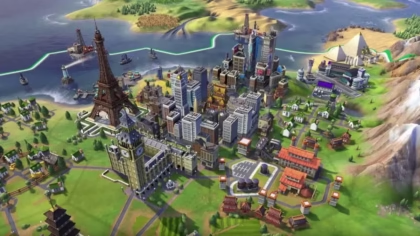
The player’s autonomy in Civ 6 makes this game one of the best strategic games ever. Every choice you make matters and requires a plan and adaptation if you wish to win. Choices are rarely made for you; the advisor occasionally makes only recommendations. Think back to capturing a city.
That required strategic placement based on the position of your adjacent units on the defensive land. The production used to train them in the first place could come from mine improvements over hilled lands, using builders, or plugging in the militaristic policy card, Agoge, which provides 50 percent production toward ancient and classical melee, ranged and anti-calvary units to mass produce the military units needed to capture that city. Other choices, such as gold, faith, religion and unit promotions also affect the course of war.
And that’s just war alone. Diplomacy between nations, building infrastructure to improve your yields—campus districts for science, theatre squares for culture, commercial hubs for gold, and more—exploration of new lands, and whatever else your heart desires—all require your expertise to achieve your goal or win condition, leading to a satisfactory playing experience.
Finally, the vibe of building an empire is cool and somewhat somber, given how far humanity has come through the course of civilization. The art is beautiful and cartoonish, fitting the game’s aesthetic, especially the cinematic intros that trace the course of human civilization. The lines Sean Bean delivers after researching a technology or a civic adore me. The music is what really enthrals me in Civ 6 and, really, in any Civ or strategy-based game. It really captures the feels and portrays all the cultures of historical nations and tribes. It makes me proud to experience life in civilization on this earth and learn from its past. That is why I encourage you, if you love history, civics and strategy games, that Sid Meier’s Civilization 6 is the way to go.