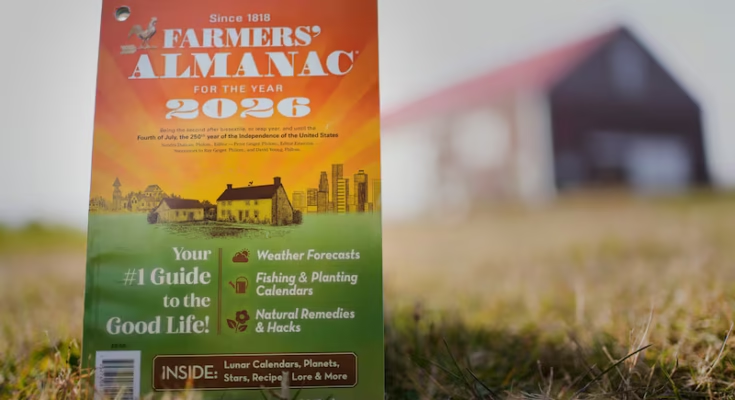
The Farmers’ Almanac will be ending its more than 200-year run with the 2026 edition.
An almanac is an annual publication that details information about the year. When it comes to the Farmers’ Almanac, it is a calendar that records and predicts events such as sunrise, ocean tides, weather cycles and other phenomena. However, it contains predictions for much more than just farming; it includes various additional topics such as the best time to get married, weaning animals, going fishing and much more.
The Farmers’ Almanac was founded in 1818 by David Young and Jacob Mann. It is one of two farmer’s almanacs that are well known, and the two are commonly confused. The other almanac, called Old Farmer’s Almanac, was founded in 1792 by Robert B. Thomas and is the oldest continuously published periodical in North America.
Some of the main differences between the two are the weather forecasting approaches and their gardening guidance. In the Farmers’ Almanac, a formula based on sunspots, tides and planet positions is used to predict weather, covering seven climate zones. On the other hand, the Old Farmer’s Almanac uses a combination of historical weather patterns, solar cycles and modern satellite data to predict the forecast, and it divides the United States into 18 regions. While they both provide planting charts, frost tables and soil tips within their almanac, the Farmers’ Almanac sticks to traditional organic methods in their gardening tips. On the other hand, The Old Farmer’s Almanac incorporates modern gardening techniques into its guides.
The 1818 Farmers’ Almanac is coming to an end soon. Research conducted by The Daily Dot reveals that the reasons for its discontinuation include a rise in production costs, a decline in sales and an increase in the use of digital technology to get the same results as the almanac.
The almanac is printed and distributed annually, and the production cost has become increasingly more expensive over the last few years. Fewer readers are buying the physical copies, so the funds to pay for the prints are not coming in. Instead, people are choosing to use apps and online websites for their information as it is quicker and easier, so the necessity of the almanac’s predictions is quickly being reduced.
The almanac gives a sense of nostalgia for many farmers and their families, as it has been a part of their families for generations. One such person affected by the discontinuation of Farmers’ Almanac is Mark McMinn. McMinn is the Inventory Control at Weakley Farmers Co-Op. He comes from a family of cattle farmers, who have been getting the almanac for generations, and has followed in their footsteps. He receives them regularly for his store.
“We get it with our calendar when we get them, it’s on our calendar,” McMinn said.
McMinn mainly uses the almanac to know when the best time is for him to wean or dehorn his calves. He claims that when he weans his calves when “the signs are right,” the calves will not cry as much as they would otherwise. It seems that the almanac’s predictions really work.
McMinn has used the almanac his entire life, and so have his parents before him. It’s a generational thing for his family. He assumes the reason the almanac is going out of business is that the younger generation does not use it.
“There’s more involved in the printing of the almanac,” McMinn said. “The younger generation probably does not care. They just do it when the knife is sharp or when the ground is ready.”
However, McMinn acknowledges the trend of using internet websites for information instead of the printed calendar. While he still has a copy of the almanac in his office, he more commonly uses Google to find the dates and uses the calendar as a backup. Even with this, however, he still wishes that they weren’t being discontinued.
“I didn’t know [they were discontinuing it],” he said. “I hate to see it go. It’s nostalgic, its history. It goes as far back as my time, and the old timers.”
The effects of the Farmers’ Almanac ending are being felt by more than just farmers. Some students are also feeling the sting.
One such person is Sam Baker. Baker is a student at the University of Tennessee in Martin majoring in agricultural engineering technology. Even though he has never personally used it, his family has for generations, and he still gets one even to this day.
“My great-grandparents lived by the almanac,” Baker said. “I get it merely for nostalgia, that’s the whole reason I get it. I don’t actually go by it. I still don’t like to see it go, though.”